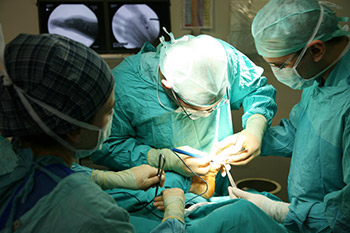
Relief for Painful, Inflamed Heels at Park Plaza Foot Specialists, Houston
Sharp foot pain, aching or stiffness on the bottom of one or both heels is a very common ailment. The pain is often at its worst upon awakening in the morning (or after sitting down for an extended period and then resuming activity), causing hobbling or limping for a few minutes before a comfortable stride can be resumed. As weight continues to be applied during walking or standing, mild or severe pain may persist.
At our medical center in Houston, we have seen that adults-whether office worker, laborer or athlete develop the problem most frequently, although children, too, can be affected if the growing bone becomes irritated.
Causes of Heel Pain
Heel pain originates deep within the foot, directly on the heel bone or within the foot's connective tissues, called the fascia.
Several layers of fatty tissue surround the heel bone, softening the impact or walking and running and protecting the bones and muscles of the foot. Beneath this padding, a fibrous band of connective tissue (the fascia) extends from the heel bone, supports the arch and reaches across to the toes. Pain can result when these tissues become irritated or inflamed, or when small spurs grow on the heel bone.
Inflammation
Most cases of heel pain are characterized by inflammation. First, the fascia begins to pull on the bone and the tissues become irritated, then inflamed. Inflammation of the fascia is called fascitis.
Heel Spurs
A projection or growth of bone may be called a spur, and can grow where the muscles of the foot attach to bone. While some heel spurs are painless, others that are determined to be the cause of chronic heel pain may require medical treatment or surgical removal (see "Surgical Treatments for Heel Pain").
Other Causes
While injury, overuse or other temporary, mechanical causes can bring on discomfort in the heel, a painful heel may also accompany a more serious condition, such as:
Illnesses like these and others must be diagnosed and treated separately. Your podiatric surgeon may refer you to a local specialist if the problems are beyond his or her area of expertise.
Caring for the Painful Heel
In most cases, heel pain can be relieved without surgery. Treatment may include self-care, medications, therapy or orthotics.
Self-Care
Several steps can be taken to care for a painful heel at home.
If self-care measures do not relieve the foot pain, the podiatric surgeon may recommend various treatments to reduce inflammation. Some of these may include:
Surgical Treatments for Heel Pain
If nonsurgical medical treatments fail and pain persists, surgical intervention may be necessary.
Both surgical procedures described below are usually completed on an outpatient basis in less than one hour. They are performed comfortably under either local anesthesia or minimal sedation administered by trained personnel.
Removal of Connective Tissue (Fascia)
During surgery to separate all or a portion of the fascial tissue from the heel bone, the podiatric surgeon will make a small incision on the inside of the heel. Then, the tissue is carefully cut away (see illustration A). A few stitches will be required.
Bone Spur RemovalHeel spurs may be removed during the same operation for separating the connective tissue from the heel bone.
After the tissue has been detached, the podiatric surgeon will remove any spurs, leaving the heel bone smooth (see illustration B).


Postoperative Care
Immediately after either operator, a plaster cast may or may not be used to support and immobilize the foot for two to three weeks. Crutches may be helpful for greater comfort and mobility while the foot heals.
When the cast has been removed, three to four weeks of physical therapy will speed healing and reduce swelling.
Provided there are no complications, recovery is usually complete in six to eight weeks.
When Can Usual Activities Be Resumed?Normal daily activities can be gradually resumed as soon as pain subsides, or when recommended by the podiatric surgeon. Within a few days after surgery, most people begin moving comfortably. As recovery continues, activities can gradually increase.
How Can Heel Pain Be Prevented?Unfortunately, prevention is not always possible. If pain is related to too much activity or an abnormal foot structure (such as flat feet or high arches), modifying the daily routine to exclude activities that are stressful on the feet, should be considered. For example, jogging should be replaced with biking and/or swimming. If symptoms of heel pain develop, icing the foot should begin immediately.
If the problem still persists, consult our podiatric surgeon in Houston and get relieved from the ailment.